NOT DEAD YET
Recently I've been on and off SMT: Strange Journey, a delightful little RPG for the DS (all these acronyms), but I've hit a snag. It's nothing difficult, in fact, it's not even a fight or puzzle or anything of that sort. It's just a simple question.
The entirety of SMT has built from the familiar D&D setup of the axis of good-evil and law-chaos, with the majority of the story and gameplay built around constructing yourself in the latter axis. "Demon co-op" occurs with a party of the same alignment, which usually dictates your party choice, and the majority of the (relatively sparse) dialog options revolve around establishing yourself in the axis. I'll be sparse, and try to be spoiler free, but as the story evolves, there becomes a pretty clear representation of law and chaos within your npc allies. From that, we get a brilliant "pleasant, morally sound authoritarian path" vs "chaotic, unpredictable freedom", in a very "The Grand Inquistor" Dostoevsky fashion.
So I've hit a branch. It's not a significant branch, it won't dictate the rest of my game in terms of what I "see" and not. It will probably change my alignment, but I can always move that back without too much time. The real problem, is that I just don't know where I stand. It's a relatively simple question, even when you consider the philosophical consequence, but it's one I can't come to a conclusion of. Do we need freedom if we have happiness? Is freedom worth it if it causes pain? So on and so forth.
On reflection of the issue, I have never had this sort of conundrum in a game. It's not that I've played no other, or even too few games that have branching dialog options, I've played your Bioware games and your Bethesda games and your Bioshocks and that sort, but I think there's a fundamental difference between what's going on with these questions.
For Bethesda, it's mostly just gameplay choices. Maybe you try to manipulate some karma system or some other morally sophomoric "good vs evil" thing, but for the most part, the questions are ones of the "experience". Rarely does it demand you to think beyond "what would i rather see" or "what would I rather this character do" and of what does, it's mostly "should I kill this innocent person just to be an ass or should I just let him keep his money" (or what have you).
I have to suggest it's the same for Bioware. Clearly, just by the narrative presentation, and the discussion of the developers, they are intending a sophisticated narrative, one with deep lore and relatable characters and emotional scenarios, but I think when it comes to the dialog choices, it's still much about "what you want to experience". In fact, they even explicitly tell you what is "renegade" and what is "paragon" (or light side/dark side or whatever the moral "gimmick" of the game is). The questions aren't about establishing what YOU the player is, it's about what you the player want to create for you the actor. Some choices will have you questioning your choice, but as far as I can tell, they are more of "who do I want to live/die" or "who do I like more" and stuff like that. It's rare (if not non-existent) that one of these choices probe the player's motivations.
Bioshock, however, does try to make this sort of decision. With the harvesting of the little girls, it's an extreme example of self-importance or making it hard on yourself for the sake of a "probably lost cause". The problem here is two fold. For one, it's a not at all a translatable example. In light of the Randian world of the game, it's likely that it's intended to be a play on the importance of the self in light of institutional errors and such, but it comes off as "be a monster or be a nice guy". The second problem is that the game, even from the start, destroys the supposed advantage that sacrificing the lil sis should give, as a "gift" is proposed by the lil sis' leader of sorts. It could work on a philosophical point, that even when you believe you're supporting yourself, you would be better supported helping the community or whatever, but it weakens the aspect of a point. So maybe it's not intended to be a significant choice, but it fails on a moral level.
I have to posit that those are overly-simple, pointless questions. Strange Journey has several similar to that: Shaking someone's hand, helping a demon in need, so on and so forth, but as it constructs itself in the game at large, we can develop a number of things. These questions formulate what the demons are, what they represent. They help identify your (the player's) persona, giving a dynamic example of a question of life (such as the "what if you find out your wife is a robot?" question for the application of free will). There may be a need for something like Bioware narrative or Bethesda narrative, they lead to comedy, emotional despair, accomplishment, etc., but with the discussion of "what does it mean for a game to be art?" shouldn't we be critical of what it means to be questioned? Shouldn't games be more interested in what they are asking the PLAYER? They want us to want to BE the main character, but aren't we just making the main character in our own narrative light? When do you feel something like Mass Effect probes you to question yourself, rather than your actor?
I think I'd like to hear comments about this, so while you think of an answer I'll be thinking about what to do with myself in the Schwarzwelt.
Monday, August 27, 2012

Friday, July 20, 2012
ICO: dissecting Ueda and his original masterpiece
As I'm banned from the boards (again!) I think I should feel compelled to do a post and with yet another assurance that The Last Guardian is still being made, perhaps now is the time to do a retrospective of what I've previously considered and possibly still do as the greatest game created.
To start off, here is a short list of games I've seen Ueda mention as games he's enjoyed or influenced by or some such:
Another World
Half Life 2
Burnout 3
Katamary Damacy
Portal 2
God of War (why?)
Obviously several of these... in fact almost all of them have no influence on him in direct relation to ICO, but certainly the character of his tastes will come out in his games, and certainly when he constantly derives his taste to making games that he "thinks he wants to play".
Another World is the most obvious influence of his, and because of this it will also demand the most attention and time so it, along with Half Life 2 and Portal 2 will be discussed last so first let us consider one of the choices that shall seem quite oddball considering a game that first and foremost is a quiet, subdued adventure: Burnout 3. A quick look at reviews for this high-octane racing game shows a dictionary of buzz words even more buzzy than high-octane including "intense", "electrifying", "heart-pounding", and "adrenaline pumping" (inducing?, not sure of the best wording), but of what I've seen a curious lack of "kinetic". The kinetic impact of Burnout is certainly what sets it apart, in a game thriving on ridiculous, nearly uncontrollable speeds, the focus on the crashes creates an odd moment for meditation, watching an opposing car float helplessly through the air in an oddly serene moment of destruction. The real satisfaction of such a moment is not the visceral destruction-porn of watching mangled bits of metal and perhaps the unconscious notion of "perhaps there's an equally mangled body in that mess", but rather that connection between cars. In that brief moment right before it all slows down you can FEEL the kinetic impact of the cars. In a fantastic moment of immersion, the game is able to send an impossible experience to the player. Perhaps this is more reasonably discussed when talking about that brilliant TISH that comes from sinking our sword in the giants of Shadow of the Colossus but, although less prevalent, it is an important aspect of ICO. The most notable aspect of ICOs combat is really how clunky little ICO is with his weapon. He holds the sword as if it's far too heavy for him, and swings it like it's his first time using his arms. There is an intense lack of power in every motion you have during combat, even if you're comfortable enough with the game that you don't really have a problem dispatching your foes. This is only highlighted in the actual impact of your swings, or perhaps the lack of. Especially with your measly stick in the beginning stages of the game, your attacks are met with a seeming equivalent to a wet fart of a sound effect, and very small push of the enemies momentum in the game, but it's a perfect feeling. The small movement is enough to feel like you have a fighting chance of surviving, but still too weak too feel like it's something you can ever count on. While most games, and certainly Burnout are about the power of such events, ICO is magnificent in conveying just how weak and insignificant you are.
Which brings to mind why Ueda would ever be interested in something as agonizingly masturbatory as God of War. In God of War, there is no connection in the battles. Your swinging swords simply slice through even the most dense of enemies, and after the frequent QTEs, you're left with a gruesome, pornographic scene where you typically detach some part of the monster, eventually its life and all those health and magic blobs, and a lingering fascination of that violence (why is the center of the new God of War's marketing focused around the visceral treatment of its monstrous foes?). Perhaps his interest is only one of that fascination, and this is a case where his taste is escapism from his norms, or perhaps it only shows up in very vague moments (The adventurous, expansive arenas or the occasionally intriguing camera angles as it sweeps through those areas or the admittedly nice animations captured by it). Who knows, but I suppose it is always interesting to see a designer enjoy something so far off from their own creations.
And for something that is in fact, so close to their own creations, the coup-de-grace of this piece, ICO and Another World. For those wondering where Half-Life 2 and Portal(2) fit in, I would need another article perhaps, but Eric Chahi's brilliant Amiga masterpiece provided the framework that those games operate within (and actually a lot of interesting parallels in relation to the first Portal game). However, the parallels between ICO and Another world are not only more numerous, but something that has been explicitly stated by Fumito Ueda. Just going by the plot narrative of the games, they are incredibly similar: After arriving in a new, unfamiliar world our protagonist, after miraculously smashing his cell (yes yes yes, this happens several minutes into Another World rather than the start like ICO), finds another jailed prisoner (also of note: the familiarity between Yorda and the Another World cell-breaks). Nothing is really known or understood between the two, no familiar language, no familiar origins, and because of such, almost all interactions happen wordlessly. Shortly after that meeting, you pick up a weapon and go along your way, constantly juggling battling foes, solving environmental puzzles (occasionally with the help of your fellow prisoner), and eventually, and likely several times, get separated from your only friend. After some intensive exploration through this land (several similar locales, to be honest), the journey culminates in the desperate escape, with an uncertain end.
In terms of gameplay, the parallels come up again. The world of ICO is relatively linear, but it's never obvious where forward is. This is displayed more symbolically within Another World, curiously playing on the spacial metaphor of "right = forward", and toying with how you're forced to determine what is progress. With ICO, that same interplay and experimentation is in spacial limbo, and seemingly every environmental puzzle is just a new arena the game forces you into (much like the chapter dissection in Another World). The combat of the two games can be considered polar opposite, ICO relies on powerless defensive swings to eventually dispel your enemy, Another World relies on a one-hit gun built on its own system of building shields to provide yourself with a window of opportunity to kill your foes. The common theme is the very frantic feel it gives you, however. Because you have a one-hit-kill, does not mean you go looking for enemies to kill, it only means that that second you have to charge your shield becomes a horror moment beyond compare. When any hit can kill you, defense is paramount. ICO's defensive swings, in this light, are really more of a shielding blast than an aggressive attack to the enemy.
But more important than all that, and the guiding feature of that I suppose, is the feeling you get. In both of these games, you are lonely. Horribly, uncontrollably lonely. It's a new world, an environment you cannot even really comprehend, and you're left to escape it without anyone. When you do eventually meet your ally, it becomes even lonelier. No understanding between the two, no development within interactions, and the only real reason to connect in the beginning is only out of empathy or need. As the game advances, and as you learn to protect one another, and help one another, you get a sense of what help you can provide. The curious relation, is that it seems to be flipped in the two games. In Another World, your ally has all the power. You can defend yourself, and you will be there to help him, but more often than not, it's your ally that comes in the nick of time to pull you out of danger. However, there is a moment when this changes. In a short moment when you can imagine escape in your reach, your ally is caught by guards, forcing you to come from behind and quickly deal with that threat. Then, at the end, when it seems your ally is gone for good, you allow a chance for escape, only for your ally to come back, and pick up your near-lifeless body for the dramatic escape.
In ICO, you have the "power". It's up to you to keep Yorda alive for pretty much the entire game, and it's always you that comes in the nick of time to pull her out from the shadow's portal. However, the great moment of role reversal comes towards the end of the game, as you have escape in view, and a weakened Yorda tripping behind you, the bridges moves apart. In possibly the most dramatic moment in gaming, you leave the exit behind you, and, mimicking Yorda's leap into your arms and let her catch you, her becoming the savior, and your the princess lagging behind. This does fail, however, not really suggesting that she is incapable of helping, but rather a cooperative failure, as it's now up to ICO alone to escape the castle, and save Yorda. This is the moment of despair, as you find Yorda, stoned up and seemingly dead. This is also the moment of redemption, in the other most dramatic moment in gaming, you defend her body once again (with this incredible background noise). It's actually hard to describe this scene, and it's really the most personal. Perhaps it's built on selfishness, perhaps on intuition, perhaps on just the outwardly hope that something will work to bring her back, but, alas, she come back in the very end, to pick up your near-lifeless body for the dramatic escape.
But most importantly, these two games are very austere and encompassing. The way that Chahi and Ueda discuss these games like this, is almost similar as well. The games themselves, in their eyes, are not even really represented with what is on screen, as Ueda says (rough paraphrasing as I'm not going to look it up again) "Games are about presenting a space that a player can buy as real, and to convince the player that they are having a personal experience", or as Chahi says "For me [Another World] does not exist. It does not exist on the screen, but it exists in the player's mind". To them, games are only as strong as what can be imagined from them. A game has to have a sufficient manner in letting a player imagine from them. The ability to superimpose their dreams and nightmares into the reality that is being supposed in their screen. If there's anything to cherish about ICO, it is that it is a game that allows you to accept everything that is going on, and forces you to make relations within it. While ICO grows to love his silent ally, we feel the same connections. The game holds our hand as it guides us along on this expansive journey, and as we help it with the puzzles, it helps our loneliness and need for comfort.
To start off, here is a short list of games I've seen Ueda mention as games he's enjoyed or influenced by or some such:
Another World
Half Life 2
Burnout 3
Katamary Damacy
Portal 2
God of War (why?)
Obviously several of these... in fact almost all of them have no influence on him in direct relation to ICO, but certainly the character of his tastes will come out in his games, and certainly when he constantly derives his taste to making games that he "thinks he wants to play".
Another World is the most obvious influence of his, and because of this it will also demand the most attention and time so it, along with Half Life 2 and Portal 2 will be discussed last so first let us consider one of the choices that shall seem quite oddball considering a game that first and foremost is a quiet, subdued adventure: Burnout 3. A quick look at reviews for this high-octane racing game shows a dictionary of buzz words even more buzzy than high-octane including "intense", "electrifying", "heart-pounding", and "adrenaline pumping" (inducing?, not sure of the best wording), but of what I've seen a curious lack of "kinetic". The kinetic impact of Burnout is certainly what sets it apart, in a game thriving on ridiculous, nearly uncontrollable speeds, the focus on the crashes creates an odd moment for meditation, watching an opposing car float helplessly through the air in an oddly serene moment of destruction. The real satisfaction of such a moment is not the visceral destruction-porn of watching mangled bits of metal and perhaps the unconscious notion of "perhaps there's an equally mangled body in that mess", but rather that connection between cars. In that brief moment right before it all slows down you can FEEL the kinetic impact of the cars. In a fantastic moment of immersion, the game is able to send an impossible experience to the player. Perhaps this is more reasonably discussed when talking about that brilliant TISH that comes from sinking our sword in the giants of Shadow of the Colossus but, although less prevalent, it is an important aspect of ICO. The most notable aspect of ICOs combat is really how clunky little ICO is with his weapon. He holds the sword as if it's far too heavy for him, and swings it like it's his first time using his arms. There is an intense lack of power in every motion you have during combat, even if you're comfortable enough with the game that you don't really have a problem dispatching your foes. This is only highlighted in the actual impact of your swings, or perhaps the lack of. Especially with your measly stick in the beginning stages of the game, your attacks are met with a seeming equivalent to a wet fart of a sound effect, and very small push of the enemies momentum in the game, but it's a perfect feeling. The small movement is enough to feel like you have a fighting chance of surviving, but still too weak too feel like it's something you can ever count on. While most games, and certainly Burnout are about the power of such events, ICO is magnificent in conveying just how weak and insignificant you are.
Which brings to mind why Ueda would ever be interested in something as agonizingly masturbatory as God of War. In God of War, there is no connection in the battles. Your swinging swords simply slice through even the most dense of enemies, and after the frequent QTEs, you're left with a gruesome, pornographic scene where you typically detach some part of the monster, eventually its life and all those health and magic blobs, and a lingering fascination of that violence (why is the center of the new God of War's marketing focused around the visceral treatment of its monstrous foes?). Perhaps his interest is only one of that fascination, and this is a case where his taste is escapism from his norms, or perhaps it only shows up in very vague moments (The adventurous, expansive arenas or the occasionally intriguing camera angles as it sweeps through those areas or the admittedly nice animations captured by it). Who knows, but I suppose it is always interesting to see a designer enjoy something so far off from their own creations.
And for something that is in fact, so close to their own creations, the coup-de-grace of this piece, ICO and Another World. For those wondering where Half-Life 2 and Portal(2) fit in, I would need another article perhaps, but Eric Chahi's brilliant Amiga masterpiece provided the framework that those games operate within (and actually a lot of interesting parallels in relation to the first Portal game). However, the parallels between ICO and Another world are not only more numerous, but something that has been explicitly stated by Fumito Ueda. Just going by the plot narrative of the games, they are incredibly similar: After arriving in a new, unfamiliar world our protagonist, after miraculously smashing his cell (yes yes yes, this happens several minutes into Another World rather than the start like ICO), finds another jailed prisoner (also of note: the familiarity between Yorda and the Another World cell-breaks). Nothing is really known or understood between the two, no familiar language, no familiar origins, and because of such, almost all interactions happen wordlessly. Shortly after that meeting, you pick up a weapon and go along your way, constantly juggling battling foes, solving environmental puzzles (occasionally with the help of your fellow prisoner), and eventually, and likely several times, get separated from your only friend. After some intensive exploration through this land (several similar locales, to be honest), the journey culminates in the desperate escape, with an uncertain end.
In terms of gameplay, the parallels come up again. The world of ICO is relatively linear, but it's never obvious where forward is. This is displayed more symbolically within Another World, curiously playing on the spacial metaphor of "right = forward", and toying with how you're forced to determine what is progress. With ICO, that same interplay and experimentation is in spacial limbo, and seemingly every environmental puzzle is just a new arena the game forces you into (much like the chapter dissection in Another World). The combat of the two games can be considered polar opposite, ICO relies on powerless defensive swings to eventually dispel your enemy, Another World relies on a one-hit gun built on its own system of building shields to provide yourself with a window of opportunity to kill your foes. The common theme is the very frantic feel it gives you, however. Because you have a one-hit-kill, does not mean you go looking for enemies to kill, it only means that that second you have to charge your shield becomes a horror moment beyond compare. When any hit can kill you, defense is paramount. ICO's defensive swings, in this light, are really more of a shielding blast than an aggressive attack to the enemy.
But more important than all that, and the guiding feature of that I suppose, is the feeling you get. In both of these games, you are lonely. Horribly, uncontrollably lonely. It's a new world, an environment you cannot even really comprehend, and you're left to escape it without anyone. When you do eventually meet your ally, it becomes even lonelier. No understanding between the two, no development within interactions, and the only real reason to connect in the beginning is only out of empathy or need. As the game advances, and as you learn to protect one another, and help one another, you get a sense of what help you can provide. The curious relation, is that it seems to be flipped in the two games. In Another World, your ally has all the power. You can defend yourself, and you will be there to help him, but more often than not, it's your ally that comes in the nick of time to pull you out of danger. However, there is a moment when this changes. In a short moment when you can imagine escape in your reach, your ally is caught by guards, forcing you to come from behind and quickly deal with that threat. Then, at the end, when it seems your ally is gone for good, you allow a chance for escape, only for your ally to come back, and pick up your near-lifeless body for the dramatic escape.
In ICO, you have the "power". It's up to you to keep Yorda alive for pretty much the entire game, and it's always you that comes in the nick of time to pull her out from the shadow's portal. However, the great moment of role reversal comes towards the end of the game, as you have escape in view, and a weakened Yorda tripping behind you, the bridges moves apart. In possibly the most dramatic moment in gaming, you leave the exit behind you, and, mimicking Yorda's leap into your arms and let her catch you, her becoming the savior, and your the princess lagging behind. This does fail, however, not really suggesting that she is incapable of helping, but rather a cooperative failure, as it's now up to ICO alone to escape the castle, and save Yorda. This is the moment of despair, as you find Yorda, stoned up and seemingly dead. This is also the moment of redemption, in the other most dramatic moment in gaming, you defend her body once again (with this incredible background noise). It's actually hard to describe this scene, and it's really the most personal. Perhaps it's built on selfishness, perhaps on intuition, perhaps on just the outwardly hope that something will work to bring her back, but, alas, she come back in the very end, to pick up your near-lifeless body for the dramatic escape.
But most importantly, these two games are very austere and encompassing. The way that Chahi and Ueda discuss these games like this, is almost similar as well. The games themselves, in their eyes, are not even really represented with what is on screen, as Ueda says (rough paraphrasing as I'm not going to look it up again) "Games are about presenting a space that a player can buy as real, and to convince the player that they are having a personal experience", or as Chahi says "For me [Another World] does not exist. It does not exist on the screen, but it exists in the player's mind". To them, games are only as strong as what can be imagined from them. A game has to have a sufficient manner in letting a player imagine from them. The ability to superimpose their dreams and nightmares into the reality that is being supposed in their screen. If there's anything to cherish about ICO, it is that it is a game that allows you to accept everything that is going on, and forces you to make relations within it. While ICO grows to love his silent ally, we feel the same connections. The game holds our hand as it guides us along on this expansive journey, and as we help it with the puzzles, it helps our loneliness and need for comfort.
Wednesday, June 20, 2012
(Less Than) Formal Review: Lollipop Chainsaw

"If Suda 51 made music, he'd create the most engrossing masterpiece ever, and then throw in a tacky 5 minute guitar solo"
(note: I have not finished Lollipop Chainsaw, so this is subject to change... perhaps)
Killer7 is an incredible game. Flower, Sun, Rain is a wonderful narrative surrounded by a narratively consistent, if a bit agitating, puzzle gameplay. No More Heroes is a poignant meta-narrative (even if it's sort of a big "fuck you"), with a fun, simple combat system. Lollipop Chainsaw is a boring, immature horror-comedy on a tired premise and a tongue-through-cheek treatment of female personas.
It's really a far extreme from Suda 51 games: games where the story, visual, and sound design are ABOVE top notch. Games that are so well presented and so substantial that it hurts. The problem with those games, however, is that the gameplay was either sterile, or just underdeveloped. It's not always a chore, Killer7 has enough feedback and weight to get yourself into the on rails adventure/shooting of the experience, and No More Heroes really was just downright fluid. On Suda's other hand, we get Lollipop Chainsaw, a game with TOO much style, and a game that actually seems to focus on gameplay, first and foremost.
People have denounced Lollipop Chainsaw's combat, claiming that it doesn't flow until you have combos (just a note: when you get combos, the actual connections between the combos don't change. Saying it doesn't flow until you get combos is like saying it a game would flow well if every movement you made led to a cinematic presentation of that move, but i digress), or saying that it's just mindless and slow. Maybe this is just a problem with lower difficulties (you can't just button smash on hard, for sure), maybe this is just how some reviewers felt right to play the game, I'm not sure, but it's not an experience I share.
The combat system is very simple, pretty much standard for action games, a button for weak attacks, button for strong attacks, button for "different attack" (in this, it's a low attack, meant to remove legs, a good strategy in this game), and one button is evade. The attacks are suitably satisfying, before you have combos, you have weak attacks, quick to start, quick to end, and you can immediately exit the combo into a strong attack or an evade (usually the better choice), you have strong attacks that are slow and usually dismember, etc. The evade is really the main mode of attack however, and it is where the most fluidity comes from. Evasions, unlike something like God of War, aren't just evasive, and early on they are more of a mode to chain your attacks. Lollipop Chainsaw has a surprising awareness of space, when it comes to combat. You have many enemies, with varying ranges of attacks, some can attack well, some just take a while to kill, some need to be killed as first priority, and the entire way you engage battles has to be focused on getting positioning. Using evasion to dropkick enemies away, or just getting the enemies you want ahead of you is really more important than actually attacking them. If you evade, get three hits, evade, etc, you have a relatively successful method for the majority of enemies. It makes the game very fast and flashy, jumping and leaping around like a... cheerleader, and homing in on enemies, knocking them silly and finishing. It's engaging, and it really suits the actual character of Juliet.
Time to leave the combat be, however, as that's not what most people focus on. It's really not even what people care about, I mean, THIS IS SUDA XD. Suda does manage to show an incredible competence and confidence in everything else, this however... I'm just not sure about. The style is there, the punk aesthetic, the decent music (this soundtrack is sorely lacking Masafumi Takada, however), and just the general approach of the game is nice, aside from all of Suda's games, this really feels like it is a game resisting mainstream appeal, until we get to the seedy underbelly where I just can't help but be disappointed: the schlock humor.
It's not really shock humor, it's just sort of the same cheeky teen perversion comedy we've heard from not only Suda, but half the comedic video games in existence, but even if this was in Suda's other games (it was), this is just where it goes to far. In other times, it had it's place, it made sense in No More Heroes series, here, it's just forced. The writing is actually nice and charming when it needs to be: Juliet really works as what everyone recalls as the popular high school hotteen, Nick is a great foil, similarly absentminded, but cautious of Juliet and their relationship of sorts, the rest of Juliet's family is actually were the best humor comes from, very nice stuff, but much of the game seems focused on the perversion of Juliet and well everything else in the game being an overt sex-symbol. Bosses talk about "Jizzing", journal-type entries on all the special zombies remark something about sexual perversions or other teen humor (retardation, potty jokes, etc.), there are always casual remarks about this sort of thing throughout the entire game. To be honest, I just want Suda to go all out and make a pinku-game, some sort of sexploitation under the veneer of a genuine narrative. Make a Jodorowsky-influenced game. Stop showing regard for tacky censorship and perversion if you're going to have that edge. It's a game that stops just short of the line in some parts, to conform, and crosses it at others, to "prove" that they don't care about conforming. Punk must just be on life support.

Yes, 4/5. As disappointed as I am when I frame it as a Suda game, it is really a joy to play. There are moments of tedium and aggravation, but I can really say I liked playing this.
Saturday, June 9, 2012
To My Fellow Loot Whores, What Drives your Unquenchable Thirst for a Virtual Arsenal?
Diablo 3. Oh boy. I purchased the game a few days ago, and despite the many issues that have been well touted by many, as well as some more individualized gameplay issues caused by my graphics card, my overall experience with the game up until this point has been pleasurable. As is to be expected with a series like Diablo, a primary draw the series retains is the vast pool of loot/gear/items, (whichever term suits your fancy), that players can acquire through their travels. At first, the sole reason I purchased the game was because of a whim, a short instance of boredom but one of those particular spouts in which the victim is inspired against all good reasoning to commit silly acts, such as purchasing a 65 dollar game, with known yet to be rectified technical issues, just to end boredom's temporary reign of a maximum hour long duration; but enough backstory.
Throughout my playtime, however, a familiar imbued, insatiable, feeling within me arose. My Loot-Whorism, after a long period of rest, has returned full force. I can hardly get enough despite the often times aggravating nature of playing the game due to lag and the like. I merely have my monk journey through vast wastes just to obtain my next piece of weaponry or armor. Being aware of just why I was playing the game, despite the few frustrations it has bestowed upon me, has caused me to contemplate just what makes me a loot whore.
I've come to the conclusion that my personal quest for that next awesome piece of gear largely stems from the small tickling "legendary" items give my imagination. I'm speaking of course of the all those loot drops with the little foot notes on them, that give a brief 1-2 sentence history on the artifact. Along with an appropriate, sensual, blood calling name such "historic" weaponry makes me salivate at the mouth. I've realized that I don't ensure that my character is geared up to retain the best possible stats too often because of this. I'd much rather hang on to the gear that has a more interesting footnote on it than one that is simply more powerful. This is likely a reason I prefer crowd control builds in such games, as my damage output can remain secondary to some degree. Of course, this isn't exactly a good philosophy when it comes to gameplay competition/practicality, but it's what I love the loot for.
What I'm really interested in, however, is why all the other loot whores out there strive for virtual armaments. Is it a thirst for power, to be the best like Ash Ketchum? An insane inclination to collect, collect collect? Simply the aesthetics certain pieces of gear provide? A similar reason to my own impractical sentiments? What, what drives you to constantly chase the dropped goodies of your foes?
I'd like to know, it'd be interesting to see what the most common root for loot thirst is.
A short aside In reagards to Diablo 3 itself; I truly hope Blizzard works out the whole online-only thing and I do regret purchasing the game for $65. Though fun, I don't believe it's worth quite this much...Not yet at least. PvP may add a bit more flavor to it.
Throughout my playtime, however, a familiar imbued, insatiable, feeling within me arose. My Loot-Whorism, after a long period of rest, has returned full force. I can hardly get enough despite the often times aggravating nature of playing the game due to lag and the like. I merely have my monk journey through vast wastes just to obtain my next piece of weaponry or armor. Being aware of just why I was playing the game, despite the few frustrations it has bestowed upon me, has caused me to contemplate just what makes me a loot whore.
I've come to the conclusion that my personal quest for that next awesome piece of gear largely stems from the small tickling "legendary" items give my imagination. I'm speaking of course of the all those loot drops with the little foot notes on them, that give a brief 1-2 sentence history on the artifact. Along with an appropriate, sensual, blood calling name such "historic" weaponry makes me salivate at the mouth. I've realized that I don't ensure that my character is geared up to retain the best possible stats too often because of this. I'd much rather hang on to the gear that has a more interesting footnote on it than one that is simply more powerful. This is likely a reason I prefer crowd control builds in such games, as my damage output can remain secondary to some degree. Of course, this isn't exactly a good philosophy when it comes to gameplay competition/practicality, but it's what I love the loot for.
What I'm really interested in, however, is why all the other loot whores out there strive for virtual armaments. Is it a thirst for power, to be the best like Ash Ketchum? An insane inclination to collect, collect collect? Simply the aesthetics certain pieces of gear provide? A similar reason to my own impractical sentiments? What, what drives you to constantly chase the dropped goodies of your foes?
I'd like to know, it'd be interesting to see what the most common root for loot thirst is.
A short aside In reagards to Diablo 3 itself; I truly hope Blizzard works out the whole online-only thing and I do regret purchasing the game for $65. Though fun, I don't believe it's worth quite this much...Not yet at least. PvP may add a bit more flavor to it.
Wednesday, May 23, 2012
Stories and Environments: a Comparative Look at the Environments of Demon's Souls and Dark Souls
As of late, on the off chance I'd have a break to play console games, I've been devoting my time to Dark Souls, the acclaimed successor to Demon's Souls that I'm sure avid gamers, especially RPG fans are familiar with. I'm close toward the end of the game, much like my Demon's Souls play through, I began the game, took a several month leave of it, then returned and began to rush toward completion in a mad dash of sorts. And I'll admit, I'm having quite a lot of fun with it. The gameplay, specifically the peerless combat system, is just as solid as it was in Demon's Souls, the characters are quirky and memorable, and the boss fights(Though I find them, just as I did in the predecessor, fairly easy going and often a quick ordeal) are gratifying.
But something seems odd in Dark Souls, something is missing. It lacks the enticing spark that drew me back to Demon's Souls time and time again after I had completed it, and completely engrossed me into the world, to such an extent that I even considered naming a band after one of the characters(I didn't, hah!). At first I didn't know what it was about the game that seemed to perturb me, seemed to prevent the same obsession with which Demon's Souls grasped me. My first thought was that perhaps it was the minuscule, but noticeable, change in graphical style, which turned out to be faulty, as I quickly grew accustomed to it and found it fine. After that, I examined the characters, perhaps it was a lack of life in them that made it feel weak to me? Again, I was wrong, if anything the characters are extremely well modeled and given suitable voice actors and dialogue, making their often blatant absurdity believable, hell, near plausible. It was obvious from the get go that the gameplay was not the issue either, and even surpasses the prior series entry by retaining a bit more balance between combat styles(I think. IE: Magic isn't OP as hell, though Dark Souls isn't completely innocent of exploitative and "easy mode" play styles) Then I turned to what I saw as the only remaining factor; the environments, and I had finally nailed it.
Now, it's not the environments themselves that sort of detract from immersion for me (if that has any sliver of sense to it.) But rather, I find, the lack of their cohesiveness. When I first started to have an inkling that the environments were the primary culprit for my disappointment in the game I determined to pay a visit back to Demon's Souls to see if I could accurately state that the difference in environments, and their respective presentation and handling was the barrier laying between Dark Souls and myself.
Part of what I think really made Demon's Souls so great was the cohesiveness and rich implied history of its various environments. The game's zones made sense, they had a developed, yet underplayed backstory to them, it fueled the ability of the player to derive stories from the zone, to imagine its past, to ponder the events that led to its current state, and what events may be in store for them in this dangerous area. Take for example, Demon'S Souls 3rd zone, Tower of Latria. Here's an excerpt from the contents of the game;
" The Tower of Latria was a shrine devoted to the Ivory Queen in the lands neighboring Boletaria. With her husband, Latria ruled her kingdom - encompassing a penitentiary, a church, and the great tower itself - to the great adoration and respect of her people. Latria banished her husband from the lands for unknown reasons, and when the fog bathed the kingdom, Latria’s husband found himself filled with a terrible and vengeful lust. He soon discovered the source of his mad desires - a beautiful and flowing golden garb that seemed to beckon his name. When he put the robe on, a rage filled within him. The old man returned and ordered his wife exiled from her own kingdom and her family imprisoned in the cells Latria formerly governed. In each cell block, the old man commanded inhuman guards to keep watch over the tortured prisoners for eternity. He oversaw the construction of an idol made in his wife’s image to give false hope to the inmates, and with the masses of flesh accumulated throughout the years, the old man has begun creating his own army of demons, among them the ravenous Man Eaters. Suspended from the middle of the tower is a large, mechanical heart, constructed in an effort to help maintain the old man’s own existence. The souls of the damned inside of the prison are used as life-giving sustenance to keep the heart beating. In time, the old man’s body began to whither and decay, and the golden garb - the true source of the old man’s demonic rage - beckoned a new host. With the old man rid of the robe’s life-force, he breathed his last gasp of air."
 The background story is simple enough. There isn't much going on, not much to digest, and yet it provides so much kindling for interest in it's accompanying visual manifestation; (Unfortunately there is a lack of screens of the zone on the web)
Now as I travel through the dark halls the though of the "inhuman guards" resonates in my mind. I encounter the first few shells of former men, the tower's prisoners... nothing but mindless corpses now, what have the guards done to them? I continue walking and suddenly, see one. One of them. The gaurds. Oh shit. It's grotesque, it's got a head resembling a squid and skulks toward me.. slowly. This is the same dude who decimated those prisoners, I feel fear strike me, not only because I know it's an enemy by nature, but I know why, I know his origins, I've seen the fruits of his labor first hand, all thanks to the environments accompanying descriptor making the whole experience so much richer.
In turn, I feel that Demon's Souls boasts a certain cohesiveness in it's environments, through their accompanying tales, and by design. Each world, feels like a specific area, one that's affected by the characters around it, each zone interplaying with the others. Each area also had a linearity to it, which some may find bland, but I found, as I said cohesive. It brings the zone to a close, making it feel the evermore like it's own entity, and as a result, like an excursion to the area as it's own grand adventure, internally tucked within the grander adventure that is the end goal of the game.
Dark Souls in comparison takes claim to neither of, what i consider to be positive attributes, of Demon's Souls environments. The zone/hub system was exchanged for an open world, which i don't mind on paper, but I feel that when implemented, some of that cohesiveness I so loved in Demon's Souls, and sparked my interest in it's environments, their respective histories, and the adversaries they contained. Foremost, no such short descriptions of areas as were provided in Demon's Souls exist(At least that I'm aware of), which I believe, even though such write ups on areas were secondary in nature, greatly decreases the interest of each area of the world. No longer do I have any insight as to what I'm seeing. It essentially renders first encounters with enemies to little more than a jump scare. I don't know what they are, I have no idea, they don't make my heart pound like the guard whom I understood was capable of extreme treachery. In addition, I feel that, unlike in the predecessor, Dark Soul's environments feel rather "cut and pasted". What is supposed to serve as a traversable open world winds up feeling, to me, like a loose collection of regions. The areas seem to live as separate entities, as they did in Demon's souls, however in Demon's Souls these entities were always comprised of three smaller ones, that effected each other and were of similar topography and terrain, much opposed to dark souls where one suddenly comes out on a giant lake(Which I can't tell if it's implied to be underground or not) by going through a tree in a swamp. In fact, I feel that Dark Souls, in order to make the open world format work, while still clinging to a zone sort of formula, uses a fair amount of these transition pieces of sorts, such as trees that are strictly limited to interior views, gargoyles who fly the player over a wall, though to be fair, there aren't too many of them.
Anyway, I've gone on quite long enough, but I truly believe this is why I still prefer Demon's Souls over Dark Souls. What do you think? Do you agree with my sentiments? Is either game lacking in some other area in your opinion? Do you feel that the being dependent on immersion, or even desiring it through environment and related story is frivolous, either in general or for the particular game?
I'd like to hear what anyone who gives this a read thinks. I suppose I'm back to getting my ass handed to me while I chuckle at Knight Solaire.
But something seems odd in Dark Souls, something is missing. It lacks the enticing spark that drew me back to Demon's Souls time and time again after I had completed it, and completely engrossed me into the world, to such an extent that I even considered naming a band after one of the characters(I didn't, hah!). At first I didn't know what it was about the game that seemed to perturb me, seemed to prevent the same obsession with which Demon's Souls grasped me. My first thought was that perhaps it was the minuscule, but noticeable, change in graphical style, which turned out to be faulty, as I quickly grew accustomed to it and found it fine. After that, I examined the characters, perhaps it was a lack of life in them that made it feel weak to me? Again, I was wrong, if anything the characters are extremely well modeled and given suitable voice actors and dialogue, making their often blatant absurdity believable, hell, near plausible. It was obvious from the get go that the gameplay was not the issue either, and even surpasses the prior series entry by retaining a bit more balance between combat styles(I think. IE: Magic isn't OP as hell, though Dark Souls isn't completely innocent of exploitative and "easy mode" play styles) Then I turned to what I saw as the only remaining factor; the environments, and I had finally nailed it.
Now, it's not the environments themselves that sort of detract from immersion for me (if that has any sliver of sense to it.) But rather, I find, the lack of their cohesiveness. When I first started to have an inkling that the environments were the primary culprit for my disappointment in the game I determined to pay a visit back to Demon's Souls to see if I could accurately state that the difference in environments, and their respective presentation and handling was the barrier laying between Dark Souls and myself.
Part of what I think really made Demon's Souls so great was the cohesiveness and rich implied history of its various environments. The game's zones made sense, they had a developed, yet underplayed backstory to them, it fueled the ability of the player to derive stories from the zone, to imagine its past, to ponder the events that led to its current state, and what events may be in store for them in this dangerous area. Take for example, Demon'S Souls 3rd zone, Tower of Latria. Here's an excerpt from the contents of the game;
" The Tower of Latria was a shrine devoted to the Ivory Queen in the lands neighboring Boletaria. With her husband, Latria ruled her kingdom - encompassing a penitentiary, a church, and the great tower itself - to the great adoration and respect of her people. Latria banished her husband from the lands for unknown reasons, and when the fog bathed the kingdom, Latria’s husband found himself filled with a terrible and vengeful lust. He soon discovered the source of his mad desires - a beautiful and flowing golden garb that seemed to beckon his name. When he put the robe on, a rage filled within him. The old man returned and ordered his wife exiled from her own kingdom and her family imprisoned in the cells Latria formerly governed. In each cell block, the old man commanded inhuman guards to keep watch over the tortured prisoners for eternity. He oversaw the construction of an idol made in his wife’s image to give false hope to the inmates, and with the masses of flesh accumulated throughout the years, the old man has begun creating his own army of demons, among them the ravenous Man Eaters. Suspended from the middle of the tower is a large, mechanical heart, constructed in an effort to help maintain the old man’s own existence. The souls of the damned inside of the prison are used as life-giving sustenance to keep the heart beating. In time, the old man’s body began to whither and decay, and the golden garb - the true source of the old man’s demonic rage - beckoned a new host. With the old man rid of the robe’s life-force, he breathed his last gasp of air."
 The background story is simple enough. There isn't much going on, not much to digest, and yet it provides so much kindling for interest in it's accompanying visual manifestation; (Unfortunately there is a lack of screens of the zone on the web)
Now as I travel through the dark halls the though of the "inhuman guards" resonates in my mind. I encounter the first few shells of former men, the tower's prisoners... nothing but mindless corpses now, what have the guards done to them? I continue walking and suddenly, see one. One of them. The gaurds. Oh shit. It's grotesque, it's got a head resembling a squid and skulks toward me.. slowly. This is the same dude who decimated those prisoners, I feel fear strike me, not only because I know it's an enemy by nature, but I know why, I know his origins, I've seen the fruits of his labor first hand, all thanks to the environments accompanying descriptor making the whole experience so much richer.
In turn, I feel that Demon's Souls boasts a certain cohesiveness in it's environments, through their accompanying tales, and by design. Each world, feels like a specific area, one that's affected by the characters around it, each zone interplaying with the others. Each area also had a linearity to it, which some may find bland, but I found, as I said cohesive. It brings the zone to a close, making it feel the evermore like it's own entity, and as a result, like an excursion to the area as it's own grand adventure, internally tucked within the grander adventure that is the end goal of the game.
Dark Souls in comparison takes claim to neither of, what i consider to be positive attributes, of Demon's Souls environments. The zone/hub system was exchanged for an open world, which i don't mind on paper, but I feel that when implemented, some of that cohesiveness I so loved in Demon's Souls, and sparked my interest in it's environments, their respective histories, and the adversaries they contained. Foremost, no such short descriptions of areas as were provided in Demon's Souls exist(At least that I'm aware of), which I believe, even though such write ups on areas were secondary in nature, greatly decreases the interest of each area of the world. No longer do I have any insight as to what I'm seeing. It essentially renders first encounters with enemies to little more than a jump scare. I don't know what they are, I have no idea, they don't make my heart pound like the guard whom I understood was capable of extreme treachery. In addition, I feel that, unlike in the predecessor, Dark Soul's environments feel rather "cut and pasted". What is supposed to serve as a traversable open world winds up feeling, to me, like a loose collection of regions. The areas seem to live as separate entities, as they did in Demon's souls, however in Demon's Souls these entities were always comprised of three smaller ones, that effected each other and were of similar topography and terrain, much opposed to dark souls where one suddenly comes out on a giant lake(Which I can't tell if it's implied to be underground or not) by going through a tree in a swamp. In fact, I feel that Dark Souls, in order to make the open world format work, while still clinging to a zone sort of formula, uses a fair amount of these transition pieces of sorts, such as trees that are strictly limited to interior views, gargoyles who fly the player over a wall, though to be fair, there aren't too many of them.
Anyway, I've gone on quite long enough, but I truly believe this is why I still prefer Demon's Souls over Dark Souls. What do you think? Do you agree with my sentiments? Is either game lacking in some other area in your opinion? Do you feel that the being dependent on immersion, or even desiring it through environment and related story is frivolous, either in general or for the particular game?
I'd like to hear what anyone who gives this a read thinks. I suppose I'm back to getting my ass handed to me while I chuckle at Knight Solaire.
Tuesday, May 15, 2012
Formal Review: The Elder Scrolls V: Skyrim
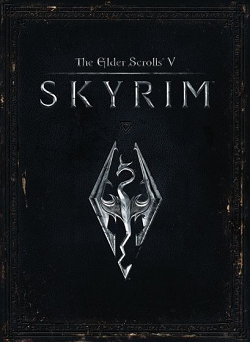
"Probably a commentary on the mid-life crisis"
I went to a graduation ceremony this past week, most of you probably have been to one, and I'm sure most have had the same experience with a commencement speaker. After a long monologue of their college career and some stories of their life, they reach the part that's "for the students", giving some words of wisdom and and "cheerio" off the the soon-to-be graduates. Of the graduation ceremonies I've been to (three thusfar), they all have at least one point in common: "Approach each day as a new adventure".
The next day I woke up with a hangover, an hour and a half long drive ahead of me, and a general distaste for everything in the world. With a recollection of the speaker's words reverberating around my head, I only now really thought about how little he really cared what he meant. He was a former NFL starter, a CIA protection agent, and an entrepreneur. I could only imagine as he said those words to us it sunk into his head that the majority will spend their days working dead-end 9-5 jobs that they really don't enjoy doing, and will likely go through the much talked about "mid-life crisis" that occurs from the monotony of those jobs. With
my hangover and grumpiness I was already going through one. I wasn't looking at the day with bright eyes
and an optimistic glare; I was looking at it as another boring day I spend doing roughly the same tasks I did the day before, and the day before, and so on.
Naturally my mind slipped to Skyrim...
I remember creating my character in Skyrim. It was a couple days after going through a couple of Arrested Development episodes, so I decided to make Carl Weathers, a strong, predator-hunting Redguard with a love of stews. I follow some rebels to get my head lobbed off when this dragon comes and wrecks all those glorious plans of removal. I follow some dude (I didn't really care who it was, as little in that scenario would) around for a bit, following his words and on-screen prompts, and came to a choice to follow guy A or guy B. At this point, I still didn't care who I was following... I choose Guy B because he was closer. So, so on and so forth, I go through the tutorial dungeon and make it to the the world.
Ah yes freedom. More than just the idea that I had a free world now, the game has (literally) taken off my shackles and given me all these options to explore, so naturally I continued to follow this guy to the near town and main quest mission. I meet these people and they tell me the main struggle of this world, I'm to help this rebellion or crush it, whatever I want.
So let's pause there. It's obvious at this point that what I choose is going to be the "winning" side, and I'm going to be the main catalyst for it. But it's not just because "that's the way a game is", but there's a narrative reason for it (seemingly): I am the DOVAHKIN (sp? idc) of lore; a mythical man and dragon tamer/translator. I've been given the role of the chosen one, destined to make some sort of change and whatever. Why is it that a game that so admires freedom puts a "destiny on you"?. Well that's pretty pointless anyway, the "destiny" is supposedly up for you to decide. What's more important, is why does every game have to make sure the player is special? Why do I have to be a destined warrior? Why am I the one all these duties fall upon? Is it just so I won't be bored?
The game makes you the NFL starter CIA agent badass that gives the commencement speech. You're allowed to look every day with a bright new glare because you're given the world and everything you can imagine to do with it... until you realize that it's as dead and decrepit as a 9-5 desk job.
In that first town I was at, I decided to walk around, pick some flowers loot some barrels... if I was going to have stew I'd have to get some ingredients... and I found a cooking pot. "GREAT" I thought to myself, "now I have the tool I need to make this stew". Well, I would if i didn't know from the start that it had no actual use, and was just given to make the world more "lively" and give it that "lived in feeling" (why is someone putting cooking pots out no where near their house?). So I sold it for some chump change and went on my way.
But let's talk about the economy of Skyrim... there is none. Each town needs approximately one store: "Things the main character needs". You get coins and you sell them to a shop, then you get potions and weapons and other assorted goods. That is, until you're midway through the game, have looted the much better special items from dungeons and have no need for the iron helmet the store is offering. The "liveliness" of the towns and stores diminishes once you realize you are the only one using it, and the items you aren't buying are just props trying to trick you into thinking the quest givers of the town have a personality.
They don't, btw. The quests are largely bland, and the dialog is certainly not top quality, but this is actually not a bad part of the game. Aside from the seemingly pointless "go kill these things" or "collect these things", they aren't terrible, and even the pointless ones have the point of making you explore.
Wait, no that is a problem. There is no reason to explore the world, for every type of player. There are some people out there that may just get satisfaction going out and looking at the different dead areas of trees and mountains. Maybe you'll come upon a cave with some bandits and a good sword.. maybe you'll get a quest. The problem is that those aren't the highlights, the highlights are finding small houses in the middle of nowhere with no one living.
Jason Rohrer once thought of a meta-game to use in minecraft. He started it by creating a file on a usb drive, and making a simple set of rules"
1.No writing boards
2.Once you die, you give the USB drive to someone else
The idea of this game is that you'd see the creations of previous players, and you'd create stories around it. You'd imagine them mining and you'd see the destruction from the different enemies of the game and this and that, and you'd think of the times they had in the world. The liveliest Skyrim ever felt to me, is when I found an Alchemist's Shack out in the middle of nowhere. Among the flowers and ingredients and stuff, there was nothing more than a note. I forget what it said, don't really care, but it left no conclusion to the story, no quest, and nothing to attack that shack to anything else in the world. I let it be after that. I thought of the idea of this alchemist, what could have happened, and where he could have gone. That was the only time I ever felt the wonderment of discovery in Skyrim. The only time I felt I was playing in a world that was lived in.
It wasn't soon after that that I approached a big spider creature I needed to get out of my way to go to the next portion of the main quest. I tapped the button to slash my sword, step backed and used some spell to attack, drank a potion as I was losing a bit of health, and carried on after looting some venom from the corpse. Every battles is basically like this. No enemies really react at all, and there's no crunch or friction in the combat. Sometimes you're not even really sure if you hit the enemy, the only clue is the little health bar moving down a bit. Well, as you go along your power attacks will occasionally cause different effects, but there's still nothing that really promotes interplay throughout the characters. I'm not asking for GOD HAND, but give me some sort of game within the combat. I don't enjoy fighting these creatures, to me they are just distractions for the walking and completing quests.
And this is where my real problem with the game lies. I don't feel compelled to explore the lifeless world, I don't feel compelled to go out fighting, and all I really feel compelled to do is just complete. This is my mid-life crisis. I don't enjoy what I'm doing, but I continue doing it on the premise that I'm getting better, and I'm getting closer to the end. I want to go get this sword, because it's going to make me stronger (even tho by getting it I'll unlock stronger enemies... thnx for that levelling system bethesda), I want to finish this quest because it will advance the storyline, etc. But as I am now, after taking a step back and looking what I was doing, I have to wonder "why?". If this is a game about discovery, the only one I've made is that I am easily distracted. That I can easily be asked to do something I don't like just to make myself fit in to a system. Skyrim is my dead end job and this endless struggle for power that comes with it is my lack of vertical, economic mobility. I've had my mid-life crisis and it's resulted in me shutting off my game.

Naturally my mind slipped to Skyrim...
I remember creating my character in Skyrim. It was a couple days after going through a couple of Arrested Development episodes, so I decided to make Carl Weathers, a strong, predator-hunting Redguard with a love of stews. I follow some rebels to get my head lobbed off when this dragon comes and wrecks all those glorious plans of removal. I follow some dude (I didn't really care who it was, as little in that scenario would) around for a bit, following his words and on-screen prompts, and came to a choice to follow guy A or guy B. At this point, I still didn't care who I was following... I choose Guy B because he was closer. So, so on and so forth, I go through the tutorial dungeon and make it to the the world.
Ah yes freedom. More than just the idea that I had a free world now, the game has (literally) taken off my shackles and given me all these options to explore, so naturally I continued to follow this guy to the near town and main quest mission. I meet these people and they tell me the main struggle of this world, I'm to help this rebellion or crush it, whatever I want.
So let's pause there. It's obvious at this point that what I choose is going to be the "winning" side, and I'm going to be the main catalyst for it. But it's not just because "that's the way a game is", but there's a narrative reason for it (seemingly): I am the DOVAHKIN (sp? idc) of lore; a mythical man and dragon tamer/translator. I've been given the role of the chosen one, destined to make some sort of change and whatever. Why is it that a game that so admires freedom puts a "destiny on you"?. Well that's pretty pointless anyway, the "destiny" is supposedly up for you to decide. What's more important, is why does every game have to make sure the player is special? Why do I have to be a destined warrior? Why am I the one all these duties fall upon? Is it just so I won't be bored?
The game makes you the NFL starter CIA agent badass that gives the commencement speech. You're allowed to look every day with a bright new glare because you're given the world and everything you can imagine to do with it... until you realize that it's as dead and decrepit as a 9-5 desk job.
In that first town I was at, I decided to walk around, pick some flowers loot some barrels... if I was going to have stew I'd have to get some ingredients... and I found a cooking pot. "GREAT" I thought to myself, "now I have the tool I need to make this stew". Well, I would if i didn't know from the start that it had no actual use, and was just given to make the world more "lively" and give it that "lived in feeling" (why is someone putting cooking pots out no where near their house?). So I sold it for some chump change and went on my way.
But let's talk about the economy of Skyrim... there is none. Each town needs approximately one store: "Things the main character needs". You get coins and you sell them to a shop, then you get potions and weapons and other assorted goods. That is, until you're midway through the game, have looted the much better special items from dungeons and have no need for the iron helmet the store is offering. The "liveliness" of the towns and stores diminishes once you realize you are the only one using it, and the items you aren't buying are just props trying to trick you into thinking the quest givers of the town have a personality.
They don't, btw. The quests are largely bland, and the dialog is certainly not top quality, but this is actually not a bad part of the game. Aside from the seemingly pointless "go kill these things" or "collect these things", they aren't terrible, and even the pointless ones have the point of making you explore.
Wait, no that is a problem. There is no reason to explore the world, for every type of player. There are some people out there that may just get satisfaction going out and looking at the different dead areas of trees and mountains. Maybe you'll come upon a cave with some bandits and a good sword.. maybe you'll get a quest. The problem is that those aren't the highlights, the highlights are finding small houses in the middle of nowhere with no one living.
Jason Rohrer once thought of a meta-game to use in minecraft. He started it by creating a file on a usb drive, and making a simple set of rules"
1.No writing boards
2.Once you die, you give the USB drive to someone else
The idea of this game is that you'd see the creations of previous players, and you'd create stories around it. You'd imagine them mining and you'd see the destruction from the different enemies of the game and this and that, and you'd think of the times they had in the world. The liveliest Skyrim ever felt to me, is when I found an Alchemist's Shack out in the middle of nowhere. Among the flowers and ingredients and stuff, there was nothing more than a note. I forget what it said, don't really care, but it left no conclusion to the story, no quest, and nothing to attack that shack to anything else in the world. I let it be after that. I thought of the idea of this alchemist, what could have happened, and where he could have gone. That was the only time I ever felt the wonderment of discovery in Skyrim. The only time I felt I was playing in a world that was lived in.
It wasn't soon after that that I approached a big spider creature I needed to get out of my way to go to the next portion of the main quest. I tapped the button to slash my sword, step backed and used some spell to attack, drank a potion as I was losing a bit of health, and carried on after looting some venom from the corpse. Every battles is basically like this. No enemies really react at all, and there's no crunch or friction in the combat. Sometimes you're not even really sure if you hit the enemy, the only clue is the little health bar moving down a bit. Well, as you go along your power attacks will occasionally cause different effects, but there's still nothing that really promotes interplay throughout the characters. I'm not asking for GOD HAND, but give me some sort of game within the combat. I don't enjoy fighting these creatures, to me they are just distractions for the walking and completing quests.
And this is where my real problem with the game lies. I don't feel compelled to explore the lifeless world, I don't feel compelled to go out fighting, and all I really feel compelled to do is just complete. This is my mid-life crisis. I don't enjoy what I'm doing, but I continue doing it on the premise that I'm getting better, and I'm getting closer to the end. I want to go get this sword, because it's going to make me stronger (even tho by getting it I'll unlock stronger enemies... thnx for that levelling system bethesda), I want to finish this quest because it will advance the storyline, etc. But as I am now, after taking a step back and looking what I was doing, I have to wonder "why?". If this is a game about discovery, the only one I've made is that I am easily distracted. That I can easily be asked to do something I don't like just to make myself fit in to a system. Skyrim is my dead end job and this endless struggle for power that comes with it is my lack of vertical, economic mobility. I've had my mid-life crisis and it's resulted in me shutting off my game.

SCORE: 2/5
Tuesday, May 8, 2012
Minecraft, The Function Of Minimal Narratives in Gaming
As many others have, I fell before the Minecraft craze back when it was just beginning to generate massive buzz, while the game was in it's late alpha stage. Now as players would know, Minecraft has been a "barebones" game since it's origins. However, as time has passed slowly but surely the game has been improved upon time and time again, not only by the developer Mojang, and the infamous Notch, but also by the fans, in the form of custom maps, mods, and character and block skins/textures. And yet, while the game has become somewhat of a juggernaut of creative content, one element remains quite miniscule, in fact, near nonexistent.
I am of course, referring to the game's narrative. For the few who may not be aware, Minecraft is an open world game, in which players are free to roam randomly generated terrains, build vast kingdoms, and slay fierce enemies. However, the game has close to no narrative, in other words, no story. Now, I think it's first important to acknowledge the fact that an open world game, as well as a game where the focus is player creativity, is not dependent upon the a lack of narrative. There are plenty of open world games with heavily present narratives, such as entries in The Elder Scrolls and Grand Theft Auto series, as well as player content generation games with narratives, such as Little Big Planet. So why exactly does Minecraft lack a clearly present narrative? And more importantly, is it effective, and what ways does it alter the players experience, and games re-playability? I shall address, both questions using my own experiences with the game, in an effort to examine the impact such a small to completely absent narrative has, and wether it is an effective choice for the gaming medium.
The Narrative of Minecraft
As I've stated, Minecraft has close to no tangible narrative. Even upon initial launch of the game no premise is given, no tutorial, prologue, or backstory of sorts is provided. In fact, the player is not even provided with so much as a mission or explanation of sorts to what their goal is in the game, such information must be gathered through pre-gathered information on the game, which isn't much of an issue, as very few people blindly download or purchase a product. Nevertheless, the game does have a very basic and obscure form of narrative in it's current version( Full Game 1.2.5). This Narrative of sorts is one of guidance for the player, and is conveyed solely through the achievement interface. As is standard, it provides the player with goals, as well as brings an added incentive through concealing achievements that require prerequisite achievements that the player has not yet acquired. This "narrative" serves a more practical purpose, as a loose guide for an optimal playing experience rather than traditional storytelling.
The only other traces of a narrative of sorts that I find within the game, lies within the end credits. After completing "The End", the designated final area of the game, the credits for the game roll, displaying a conversation between two unknown parties to the player. The dialogue between the two characters is esoteric, and largely deals with unfamiliar, until this very moment, themes of the nature of existence, as it has no prior established narrative arc, nor theme to refer to. Most players reacted negatively to this small dialogue sequence, I have a few theories as to why, which I shall delve into later.
These two facets of the game are what essentially comprises the narrative of Minecraft. As you can see, it is rather minimal.
The Effects of a Minimal Narrative, Is it Lack of Narrative Optimal For the Medium?
As established, the narrative found in Minecraft is clearly not a focus of the game. The player is given little more than simple goals of progression, which are arguably hardly even a narrative without a constructed story and characters conveying them. This said, how does the lack of a narrative effect the gameplay experience? Personally, I think it is a very good structure in Minecraft's case. It most certainly facilitates the usage of the player's imagination during playtime.
I recall my first outing into the world. I was alone, playing singleplayer, I gauged my surroundings a bit and noted that I was on a small beach, a forest with an abundance of trees stood nearby. I climbed up toward the forest and began clicking the mouse like a madman, as it was the only command I knew, and more or less needed(Aside from basic movement). I happened to hit a tree as I swung and noticed the small cracking animation be triggered. I continued to pound at the tree, and managed to chop it down with my fist, collecting the wood. I then took to the Minecraft Wiki to gather some information on how to access my inventories, as well as basic crafting information. To my dismay, when I returned to the game window I noticed the sun had just begun to set, and I had heard monsters struck at night. I quickly built a tiny hut and waited inside, in complete darkness. I heard them, I heard lots of them outside. Being the warm blooded adventurer I am, I yearned for the excitement of combating monsters, and exploring my surroundings even further, and so I braved the night. I then met a swift death, in my first introduction to the creeper, which also managed to level half of my dwelling in the process...
I could continue my tale, but you get the gist of it. It is unique to me. When i first played, and landed in my unique and random world, my mind yearned to explore the vast terrain, to conquer my foes and make my heroic stand as an adventurer. Of course, such imaginatively driven sentiments, also allowed for great conversation about the game with others. I had convinced a friend to purchase around the same time, and while we could not figure out how to establish a proper server in order to play multiplayer yet, we could not stop conversing about the game, telling tales of our explorations and dangerous forays into uncharted lands and caves, our vain attempts at trying to defend our lands from the destructive power of creepers, great tragedies befallen us in which our hard earned materials were all lost. And it was all great fun. It also caused us to talk about the gameplay itself, as we theorized on how to craft certain items, how to create elaborate creeper traps for easy tnt materials, and what block height levels to find diamonds on. Such stories work similarly in multiplayer, only they may be even more elaborate thanks to player to player interactions and planned journeys into the unknown.
This self story crafting aspect of the game shall, I think, be bolstered even further with the games next update, which plans to introduce the ability to compose in in-game books, allowing for the retention and cherishing of players extraordinary forays in the mysterious world around them. However, there also currently exists Non player characters, who dwell in villages currently serving no purpose. IT has been speculated that such Npcs may give quests in the future, the extent at which narrative backing is given to these quests, and if there is a "main quest" shall certainly effect this imaginative dynamic, though I cannot be sure to what extent.
Overall, I certainly think the lack of narrative has been beneficial for Minecraft. It urges me to return to the game, though often in binges, in order to get my fill of self catered adventures. It is, in essence, a game that's limits are the players imaginative powers. What one must wonder, however, is wether such narrative absence can work in encouraging re-playability in across genres. Perhaps such success in a lacking narrative is contingent upon many other factors? Does such a model only work for intensely player creativity focused games such as Minecraft? Do you agree that Minecraft's lack of narrative benefits the gameplay and product as a whole?
Things to mull over, in the meantime, back to crafting!
I am of course, referring to the game's narrative. For the few who may not be aware, Minecraft is an open world game, in which players are free to roam randomly generated terrains, build vast kingdoms, and slay fierce enemies. However, the game has close to no narrative, in other words, no story. Now, I think it's first important to acknowledge the fact that an open world game, as well as a game where the focus is player creativity, is not dependent upon the a lack of narrative. There are plenty of open world games with heavily present narratives, such as entries in The Elder Scrolls and Grand Theft Auto series, as well as player content generation games with narratives, such as Little Big Planet. So why exactly does Minecraft lack a clearly present narrative? And more importantly, is it effective, and what ways does it alter the players experience, and games re-playability? I shall address, both questions using my own experiences with the game, in an effort to examine the impact such a small to completely absent narrative has, and wether it is an effective choice for the gaming medium.
The Narrative of Minecraft
As I've stated, Minecraft has close to no tangible narrative. Even upon initial launch of the game no premise is given, no tutorial, prologue, or backstory of sorts is provided. In fact, the player is not even provided with so much as a mission or explanation of sorts to what their goal is in the game, such information must be gathered through pre-gathered information on the game, which isn't much of an issue, as very few people blindly download or purchase a product. Nevertheless, the game does have a very basic and obscure form of narrative in it's current version( Full Game 1.2.5). This Narrative of sorts is one of guidance for the player, and is conveyed solely through the achievement interface. As is standard, it provides the player with goals, as well as brings an added incentive through concealing achievements that require prerequisite achievements that the player has not yet acquired. This "narrative" serves a more practical purpose, as a loose guide for an optimal playing experience rather than traditional storytelling.
The only other traces of a narrative of sorts that I find within the game, lies within the end credits. After completing "The End", the designated final area of the game, the credits for the game roll, displaying a conversation between two unknown parties to the player. The dialogue between the two characters is esoteric, and largely deals with unfamiliar, until this very moment, themes of the nature of existence, as it has no prior established narrative arc, nor theme to refer to. Most players reacted negatively to this small dialogue sequence, I have a few theories as to why, which I shall delve into later.
These two facets of the game are what essentially comprises the narrative of Minecraft. As you can see, it is rather minimal.
The Effects of a Minimal Narrative, Is it Lack of Narrative Optimal For the Medium?
As established, the narrative found in Minecraft is clearly not a focus of the game. The player is given little more than simple goals of progression, which are arguably hardly even a narrative without a constructed story and characters conveying them. This said, how does the lack of a narrative effect the gameplay experience? Personally, I think it is a very good structure in Minecraft's case. It most certainly facilitates the usage of the player's imagination during playtime.
I recall my first outing into the world. I was alone, playing singleplayer, I gauged my surroundings a bit and noted that I was on a small beach, a forest with an abundance of trees stood nearby. I climbed up toward the forest and began clicking the mouse like a madman, as it was the only command I knew, and more or less needed(Aside from basic movement). I happened to hit a tree as I swung and noticed the small cracking animation be triggered. I continued to pound at the tree, and managed to chop it down with my fist, collecting the wood. I then took to the Minecraft Wiki to gather some information on how to access my inventories, as well as basic crafting information. To my dismay, when I returned to the game window I noticed the sun had just begun to set, and I had heard monsters struck at night. I quickly built a tiny hut and waited inside, in complete darkness. I heard them, I heard lots of them outside. Being the warm blooded adventurer I am, I yearned for the excitement of combating monsters, and exploring my surroundings even further, and so I braved the night. I then met a swift death, in my first introduction to the creeper, which also managed to level half of my dwelling in the process...
I could continue my tale, but you get the gist of it. It is unique to me. When i first played, and landed in my unique and random world, my mind yearned to explore the vast terrain, to conquer my foes and make my heroic stand as an adventurer. Of course, such imaginatively driven sentiments, also allowed for great conversation about the game with others. I had convinced a friend to purchase around the same time, and while we could not figure out how to establish a proper server in order to play multiplayer yet, we could not stop conversing about the game, telling tales of our explorations and dangerous forays into uncharted lands and caves, our vain attempts at trying to defend our lands from the destructive power of creepers, great tragedies befallen us in which our hard earned materials were all lost. And it was all great fun. It also caused us to talk about the gameplay itself, as we theorized on how to craft certain items, how to create elaborate creeper traps for easy tnt materials, and what block height levels to find diamonds on. Such stories work similarly in multiplayer, only they may be even more elaborate thanks to player to player interactions and planned journeys into the unknown.
This self story crafting aspect of the game shall, I think, be bolstered even further with the games next update, which plans to introduce the ability to compose in in-game books, allowing for the retention and cherishing of players extraordinary forays in the mysterious world around them. However, there also currently exists Non player characters, who dwell in villages currently serving no purpose. IT has been speculated that such Npcs may give quests in the future, the extent at which narrative backing is given to these quests, and if there is a "main quest" shall certainly effect this imaginative dynamic, though I cannot be sure to what extent.
Overall, I certainly think the lack of narrative has been beneficial for Minecraft. It urges me to return to the game, though often in binges, in order to get my fill of self catered adventures. It is, in essence, a game that's limits are the players imaginative powers. What one must wonder, however, is wether such narrative absence can work in encouraging re-playability in across genres. Perhaps such success in a lacking narrative is contingent upon many other factors? Does such a model only work for intensely player creativity focused games such as Minecraft? Do you agree that Minecraft's lack of narrative benefits the gameplay and product as a whole?
Things to mull over, in the meantime, back to crafting!
Subscribe to:
Posts (Atom)